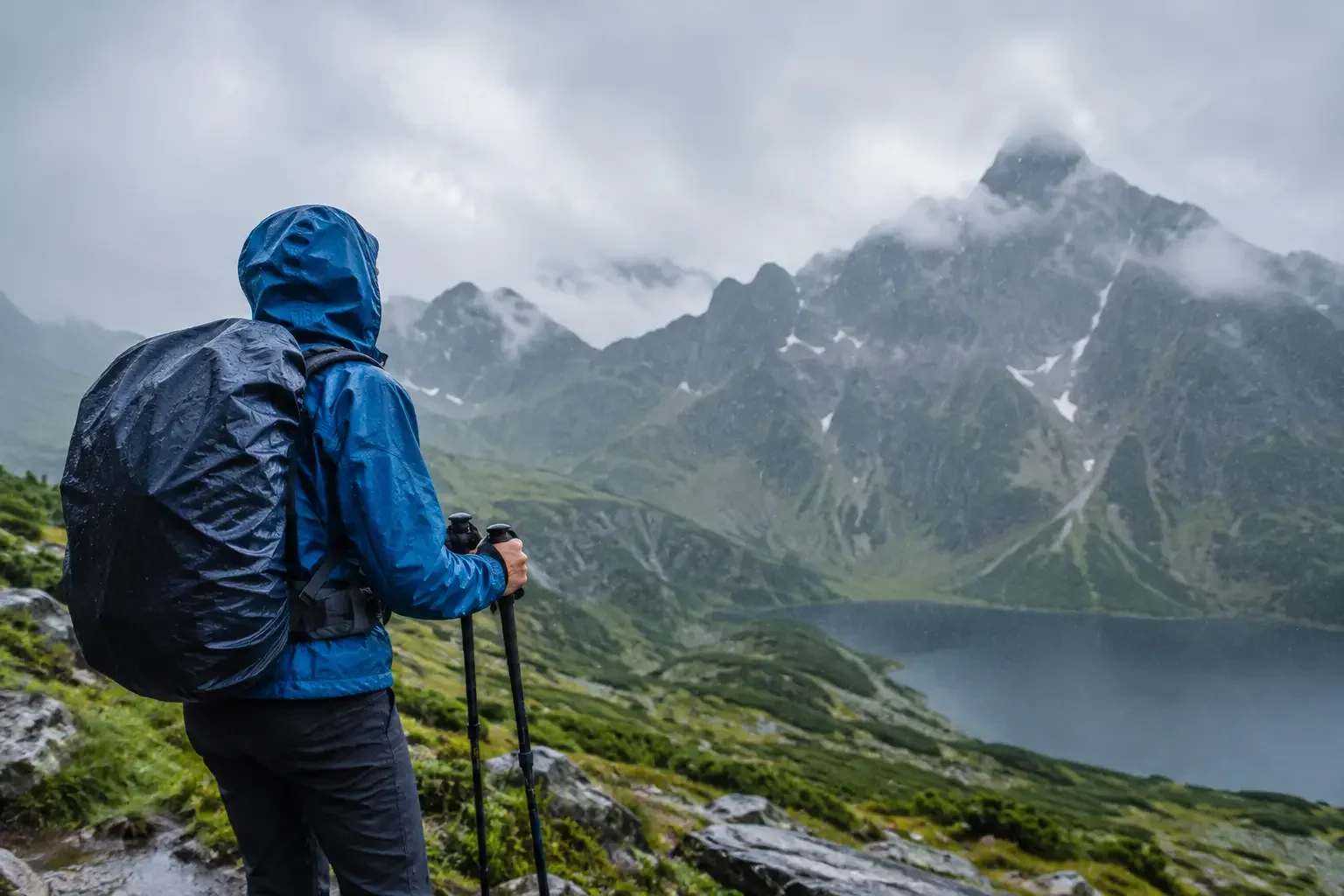
Rain in the Tatras does not automatically mean a day shut in the guesthouse. But hiking in the rain in the Tatras and safety are a pair you cannot sort out with a jacket bought yesterday in a supermarket and the optimism of “it will be fine”. In a valley, light, steady rain can be quite manageable. On a ridge, in a strong wind, in a thunderstorm, or on wet chains - that same rain turns the outing into a bad idea.
The biggest mistake? Treating rain as one category of weather. You plan a walk into Dolina Kościeliska on a calm, cool morning differently from a climb of Czerwone Wierchy when the clouds are sitting at 1,800 metres, the wind is tearing at your jacket, and the forecast shows storm cells. In the Tatras, the winner is not the person who pushes on the longest. The winner is the one who can back off before it gets truly unpleasant.
Hiking in the rain in the Tatras - safety starts before you leave
Do not look only at the cloud-with-drops icon. Check what time the rain is due to start, whether it will be showers or continuous, what the temperature will be at altitude, and the strength and direction of the wind. Ten degrees in Zakopane can mean a few degrees, wind and icy rain higher up. That is enough for someone in a cotton hoodie to start freezing faster than they can say “but it is July”.
Visibility matters too. When cloud covers the ground, you lose not only the panorama, but above all your bearings. On a wide path in a valley the problem is usually limited. On a contour path, a traverse or a broad slope it is easy to miss a sign, drop onto the wrong path, or misjudge the distance to the hut.
Before you set off, answer three questions honestly: does the route have exposed sections, does it need the use of your hands, and is there a sensible way back? If the first two answers are “yes” and the third is “not really”, heavy rain should end the discussion. An ambitious goal is not going anywhere. Wet rock is not going anywhere either.
Not every trail is fit for a wet day
In rain it is best to choose wide valleys, forest roads, gentle climbs and places you can turn back from without acrobatics. Dolina Chochołowska, Kościeliska or Strążyska can be a sensible option if there is no thunderstorm, strong wind or a sudden rise in the streams. You still have to watch the mud, slippery rocks by the water, and puddles that can pour water into a shoe more effectively than the whole downpour from above.
Leave the high parts of the Tatras, ridges, chains, iron rungs and steep descents for more stable weather. Wet rock slabs do not give a second chance to correct a badly placed foot. Especially treacherous are the polished rocks on popular trails, wooden walkways, and roots under a thin layer of mud. They look innocent until someone lands on their back or twists an ankle several kilometres from the nearest road.
There is also the matter of streams. After a long or intense spell of rain, a small brook can quickly become an obstacle you cannot cross. Do not try to jump swollen water with a backpack on, do not poke around for depth with a trekking pole at random, and do not count on “it will be fine”. If the crossing feels doubtful, turn back. Wet shoes are irritating; being swept away by the current is not.
A thunderstorm is not “heavier rain”
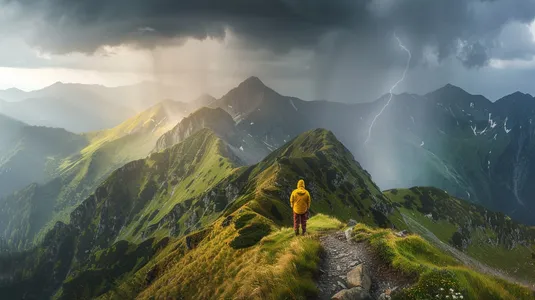
If the forecasts or the sky point to a thunderstorm, skip ridges, summits and open ground. Lightning does not need a spectacular strike on a summit cross to create a danger. Staying high, near metal protections, lone trees or watercourses is then just adding problems for yourself.
If a storm catches you already on the trail, get off exposed ground as efficiently as you can, but without running over slippery rocks. Move away from chains, streams, edges and solitary trees. Do not hide in a shallow cave or under a rock overhang if it does not give real shelter. Keep a gap from other people - if you are in a group, do not stand in one packed herd like a queue for smoked cheese.
In that situation the priority is not finishing the plan, a summit photo, or the fact that you have already paid for the room. The priority is getting down to a safer place. The Tatras will be there tomorrow, and you should still have a chance to see them.
Gear that actually works in the rain
A good rain jacket should protect you from water and wind, but it will not replace common sense. In a downpour every fabric eventually takes a beating, especially under backpack straps. That is why the whole system matters, not a magic label with a high waterproof rating.
Under the jacket put on a layer that still holds warmth when damp - a synthetic or merino wool. A cotton T-shirt soaks, cools and acts like a wet towel stuck to your back. At stops that quickly becomes a lesson in humility. In the backpack it is worth having a dry, warm layer packed in a sealed bag, a hat and gloves. Yes, in summer too, if you are going higher.
Shoes should have a sole with a clear tread and should stabilise the foot. A membrane helps, but it does not turn footwear into a submarine. When water pours in from the top, the shoe will be wet whatever it cost. On muddy trails gaiters help, and on slippery descents so do trekking poles - provided you know how to use them and are not blocking other people on a narrow path.
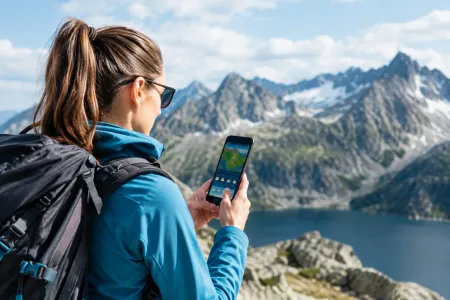
The phone must be charged and kept in a waterproof case or bag. Take an offline map, a power bank, a head torch and a basic first-aid kit. A paper map in a sealed cover still makes sense, because a phone screen in a downpour is about as cooperative as the zip on an old jacket.
Pace and decisions: this is where the mistake usually happens
Rain stretches walking time. You go slower, you keep adjusting the hood, you plant your feet more carefully, and on steep bits you look for surer holds. If an app or a trail description says four hours, do not assume you will do it in three and a half in wet conditions because you are “in shape”. Add a buffer and watch the turnaround time.
The most sensible rule is: turn back at the first serious warning, not the fifth. Worsening visibility, a rising wind, wet gloves before a chained section, someone in the group soaked through, a drop in temperature or fatigue - each of those on its own may be manageable. Together they make the classic recipe for a rescue call.
If you are walking with someone less experienced, match the trail to the weakest person, not to the most pumped-up friend. This is not a democratic vote on safety. Someone may not say outright that they are cold or afraid of the descent, because they do not want to spoil the trip. Ask specifically, take short stops in sheltered spots, and react before morale turns into panic.
When it is still worth going out in the rain
Light rain, good visibility, no thunderstorms and a valley trail can make a very pleasant day. There are fewer people, the forest smells stronger, the streams get louder, and the Tatras show a less postcard-like, but real face. It is a great moment for a calm trail, a mountain hut, a museum, or recovery before another day in the higher parts.
You do not have to bag a summit every day for the trip to be a success. Sometimes the best mountain decision is to drink tea, wait out a wall of rain, and keep your legs and nerves for tomorrow. Common sense in the Tatras does not take the adventure away - it lets you come back for the next one.

 2026-09-17
 2026-08-30
 2026-08-02
 2026-09-19
 2026-09-16
 2026-09-15
 2026-09-14
 2026-09-13
 2026-09-10
 Distance: 19.1 kmDuration: 5 h 54 min
 Distance: 15.6 kmDuration: 8 h 27 min
 Distance: 11.1 kmDuration: 2 h 59 min