planning
Scenic trails around Kasprowy Wierch
Scenic trails around Kasprowy Wierch, from Goryczkowa to the ridges. Check the cable car, the weather, the difficulty, and a sensible plan B for a day in the Tatras.
High boots or low shoes for the Tatras? See when the ankle needs support, and when a lighter shoe makes more sense on a Tatra trail.
Author: Konrad Leśniak7 min read
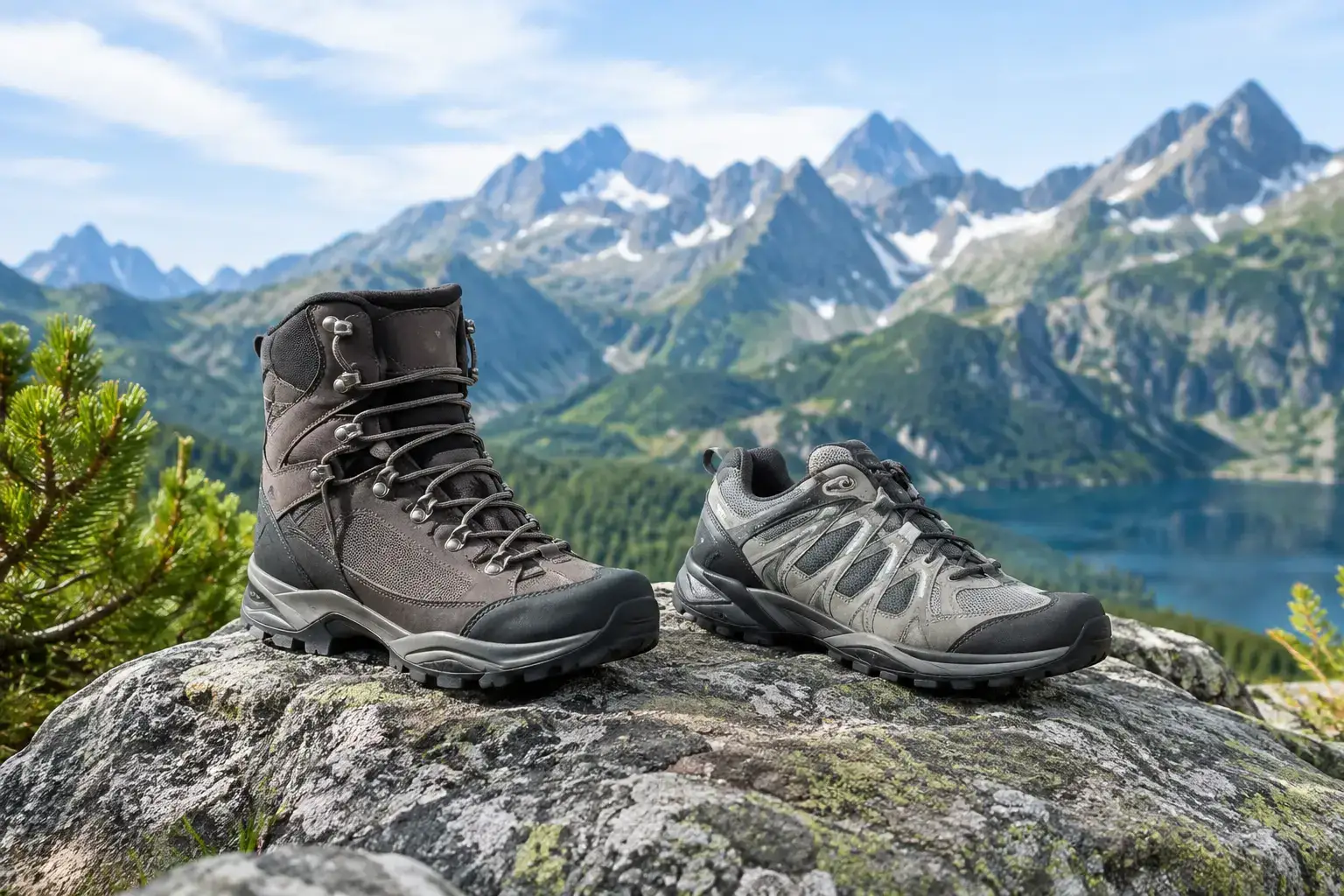
On the way down from Kasprowy Wierch, many hikers discover that the problem is no longer fitness, but their feet. Toes press into the front of the boot, the sole slips on wet rock, and the ankle works on every uneven step. The question “high boots or low shoes for the Tatras?” does not have one answer, but it has several very bad ones. The worst is: “I’ll take whatever, it’s only a walk.”
The Tatras can give you an easy day in Dolina Kościeliska, and a few hours later remind you that granite, a boulder field and a steep descent do not forgive random footwear. The height of the upper matters, but on its own it does not make a boot good kit. Fit, the sole, the route you have planned, the weather, and whether you are walking with a small pack or hauling half the flat for a three-day trip all count too.
A low shoe and a high boot are not two camps, one of which is always right. They are tools for slightly different conditions. A low model gives you lightness, freedom of movement and often a better feel for the ground. A high one protects the ankle better, keeps small stones out, and usually works better with a heavier pack, in mud and in snow.
The most important question is not “what do experienced people wear?”, but “where exactly am I going, and how confidently do I move on rock?”. Someone who walks in the mountains regularly, has strong ankles and picks a dry, well-kept trail can do an ambitious route in low hiking shoes. Someone who goes to Zakopane once a year and plans Czerwone Wierchy after rain should not copy that choice just because a low shoe looks sporty.
A high upper makes sense above all when the ground is unstable. Scree, loose stones, wet roots, churned mud and descents where the legs are already tired are the setting for stupid sprains. A boot does not lock the ankle like a brace, but it can limit the range of an uncontrolled movement and give you a bit more stability.
It is a sensible choice for long trips with a heavier pack, autumn trails full of wet leaves, and early-spring conditions when snow still lies in the shaded spots. You will also appreciate high boots when you walk into mud or wet grass. That does not mean every high upper is automatically waterproof. If water pours in over the top, or the membrane has stopped working, the height of the boot will not save much.
For valleys, easier paths and dry summer walks, a low hiking shoe or a trail shoe can be excellent. It is lighter, it dries faster, and it tires the leg less over a full day of walking. A well-chosen model with a grippy sole will do, for example, on the way to Morskie Oko, in Dolina Chochołowska, Dolina Kościeliska, or on many gentler Slovak trails.
A low shoe can also suit a capable hiker on a stonier route, but only on one condition: the person wearing it knows what they are doing. You have to be able to place your feet, keep your balance, and not speed up the descent just because the mountain hut is “surely close now”. Tiredness takes away precision. Then even the best light shoe will not stand in for sense.
If you are planning a family walk to a mountain hut, a valley trail, or an undemanding route in stable weather, good low shoes are usually enough. “Good” here does not mean city sneakers with a smooth sole. It means a model that holds the heel and does not slip on wet rock.
If you are choosing Giewont, Czerwone Wierchy, Orla Perć, Rohacze or high-Tatra trails on the Slovak side, the margin for error gets smaller. In a dry summer, an experienced person can go low. For most occasional hikers, a stable boot over the ankle will be the safer choice. Not because they will suddenly become alpinists, but because on a long, uneven descent they will get a bit more support.
The third scenario is transitional conditions: May, late autumn, rain, wet snow, a frost. Here we are not discussing catalogue comfort. The priority is grip, protection from wet, and the option to use extra kit if the conditions call for it. A low shoe with a soft sole, a soaked sock and an icy trail is a combination that can turn a calm day into a rescue. High in the Tatras, that roulette is not worth playing.
This is the point many people rely on. They buy a high, stiff model because “it will be safe”, and two hours later they have rubbed heels and bruised toenails. A boot should hold the foot, not squeeze the toes. On the descent there has to be a little room in front of the big toe, because the foot slides forward.
Try boots on in the afternoon or evening, when your feet are slightly bigger. Put on the socks you will wear in the mountains, lace the boot properly, and walk on a slope. If the heel lifts, your toes hit the front, or you feel pressure in one spot, do not count on a miraculous breaking-in. In the mountains that problem will only get bigger.
The sole matters just as much. On Tatra rock, grip gives you more than the word “trekking” on the tongue of the boot. The tread should be clear, and the sole stable enough that the foot does not tire on the stones. Models that are too soft are comfortable on a forest path, but on a long boulder field they can feel like walking on toy blocks.
A waterproof membrane is useful, but it is not a magic shield. On a cool, wet day it limits water coming in from outside. In the heat it can make ventilation worse, and a sweaty foot gets wet too. For dry summer walks, some people deliberately choose a boot without a membrane, which dries faster after an accidental soaking.
Do not spoil a good choice with a cotton sock. Cotton soaks up moisture and holds it for a long time, which is exactly what you do not want on an all-day walk. A hiking sock in merino wool or synthetic fibres will cut the risk of rubbing and improve comfort more than its modest size suggests.
Before you set off, also check the forecast for the height, not only for Zakopane. Rain in town and rain on the ridge are two different experiences. If storms are forecast, with a strong wind or a sudden drop in temperature, do not solve the problem by buying higher boots. Change the route or postpone the day. Kit should support good decisions, not excuse bad ones.
High boots are a sensible, all-round choice for a beginner planning longer and more uneven Tatra routes. Low shoes will be excellent for people who walk with confidence, pick easier ground, or value pace and lightness in dry conditions. Neither choice lets you stop looking at your feet.
If you are unsure, pick a route a level easier, break the boots in before the trip, and leave yourself spare time for the descent. The Tatras are much more pleasant when, on the last kilometres, you are thinking about the views, not about how to reach the car park without one more slip.
Newsletter
A few times a year: trail conditions, closures, the best time to go and new routes. No weekly spam.
Scenic trails around Kasprowy Wierch, from Goryczkowa to the ridges. Check the cable car, the weather, the difficulty, and a sensible plan B for a day in the Tatras.
How to read a Tatra tourist map: trail colours, contour lines, walking times, and the traps that help you avoid a bad decision before you leave the valley.
Mountain apps: reviews of maps, weather and rescue. What is actually worth having on your phone before a Tatra trail. Practical, and without the illusions.
These are affiliate links. If you book a stay or a ticket through them, we earn a small commission, for coffee :), at no extra cost to you.