Sometimes you have only one day, a knee is protesting after yesterday’s descent, or you are travelling with someone for whom five kilometres uphill sounds like a punishment. That is not a reason to see the Tatras only from the guesthouse balcony. Tatra sights with little effort do exist, but let us be honest about one thing: in the mountains, “without” usually means “without a walk of many hours”, not “in flip-flops, without a jacket and without a plan”.
The Tatras can give you big views from a cable-car cabin, a promenade, or after a short approach. You only have to pick the place with some sense, check the weather, and not force a high-mountain trip into the shape of a family stroll. Below are options for people who want to see a lot, walk a little, and come back without a story about rescuing a sandal from a stream.
Tatra sights with little effort - where to start
First decide what little effort actually means for you. For one person it will be half an hour on asphalt, for another two kilometres with a child in a pushchair, and for someone after an injury a cable-car ride and a few hundred metres on a flat pavement. Do not compare ambitions from the internet with your own day, your health and the weather.
The second thing is the season. In summer the biggest problems are often queues and heat, in autumn wet leaves, in winter ice, and in spring lingering snow even when the sun is shining in Zakopane. A short route in a valley can be trivial, but a viewpoint after a cable-car ride is still high up. Wind, fog and cold do not ask whether you walked there for three hours or sat in the cabin.
Views without a long climb
The ride up to Kasprowy Wierch is the shortest way to see a high-Tatra landscape on the Polish side. At the top you get raw ridges, glacial cirques and a perspective that no meadow by the road will give you. From the station you can walk a short stretch towards Sucha Przełęcz, or simply stay nearby, depending on the conditions and how sure you are of your step.
There is a catch: this is not an attraction for every day, or for everyone. In a strong wind, fog or ice, even a few hundred metres can be unpleasant. The ride does not automatically qualify you to walk down to Kuźnice. If you do not know winter conditions, and you do not have crampons and the skill to use them, go back down by cable car. That is not a disgrace. It is a normal decision.
Gubałówka and Butorowy Wierch
Gubałówka is not in the Tatras, but as a quick place to look at them it works very well, especially when fog sits in the valleys and the sun appears higher up. The funicular, the open space and a panorama from Giewont to the High Tatras do the job without a pack stuffed with food for eight hours.
It is worth walking a few minutes away from the noisiest part by the upper station. Where the human snake queueing for oscypek ends, a more pleasant view begins. The walk towards Butorowy Wierch is gentle, but after rain it can be muddy. Trainers with a sensible sole will be a better idea than city sneakers.
Lomnický štít for anyone who wants a huge panorama
On the Slovak side, a strong candidate is the ride up Lomnický štít, called Łomnicki Szczyt in Polish. It is a much more high-mountain experience than Kasprowy: the height, the exposure and the sheer amount of space stay in your head for a long time. Physically the effort is small. Logistically, less so. Tickets have to be planned in advance, and the weather can cross out the best calendar.
Do not treat it as a compulsory item just because the cable car solves the problem of the climb. Someone with a strong fear of heights can feel worse there than on a walk of many hours in a valley. If the forecast shows cloud and a strong wind, it is better to keep the money and the nerves for another date.
Short walks that still feel like the mountains
The path around Štrbské Pleso
Štrbské Pleso, Szczyrbskie Jezioro in Polish, is one of the most rewarding options for people who want a short walk in a genuinely Tatra setting. The route around the lake is easy and scenic, and it does not need the fitness for climbing a pass. You can match the length of the walk to the mood, the weather, and whether the children have just declared a strike.
It is a good choice in less certain weather too, though rain and a low cloud can hide the summits. Even then the forest, the surface of the lake and the mountain feel remain. On a wet surface, watch the slippery sections, especially if you are walking with a small child or after knee surgery.
Hrebienok and the Cold Water waterfalls
The funicular from Starý Smokovec to Hrebienok saves the most grinding part of the climb. From the top you can take a very short walk nearby, or follow a gentle trail to the Cold Water waterfalls, Vodopády Studeného potoka. This is one of those routes where you feel the mountains quickly, without having to negotiate terms of cooperation with your lungs straight away.
Proper shoes are worth wearing to the waterfalls. Paths by the water are often wet, the stones are slippery, and after heavier rain the pace drops by itself. This is not ground for an elegant stroll in white sneakers, no matter how good they looked in the car-park photo.
The whole of Dolina Kościeliska is not a walk without effort. There and back adds up to a real distance. You can still treat it in sections. Go as far as time and form allow, stop by the stream, the meadows and the limestone walls, and then turn back. The mountains do not keep a ranking for reaching the end of the valley.
For people with limited mobility, the surface matters: it is a wide road, but stony and uneven in places. A pushchair with small wheels will be fighting for its life here. An off-road pushchair, a child carrier, or a walk with no kit at all are more sensible options.
The road to Morskie Oko - only with the right expectations
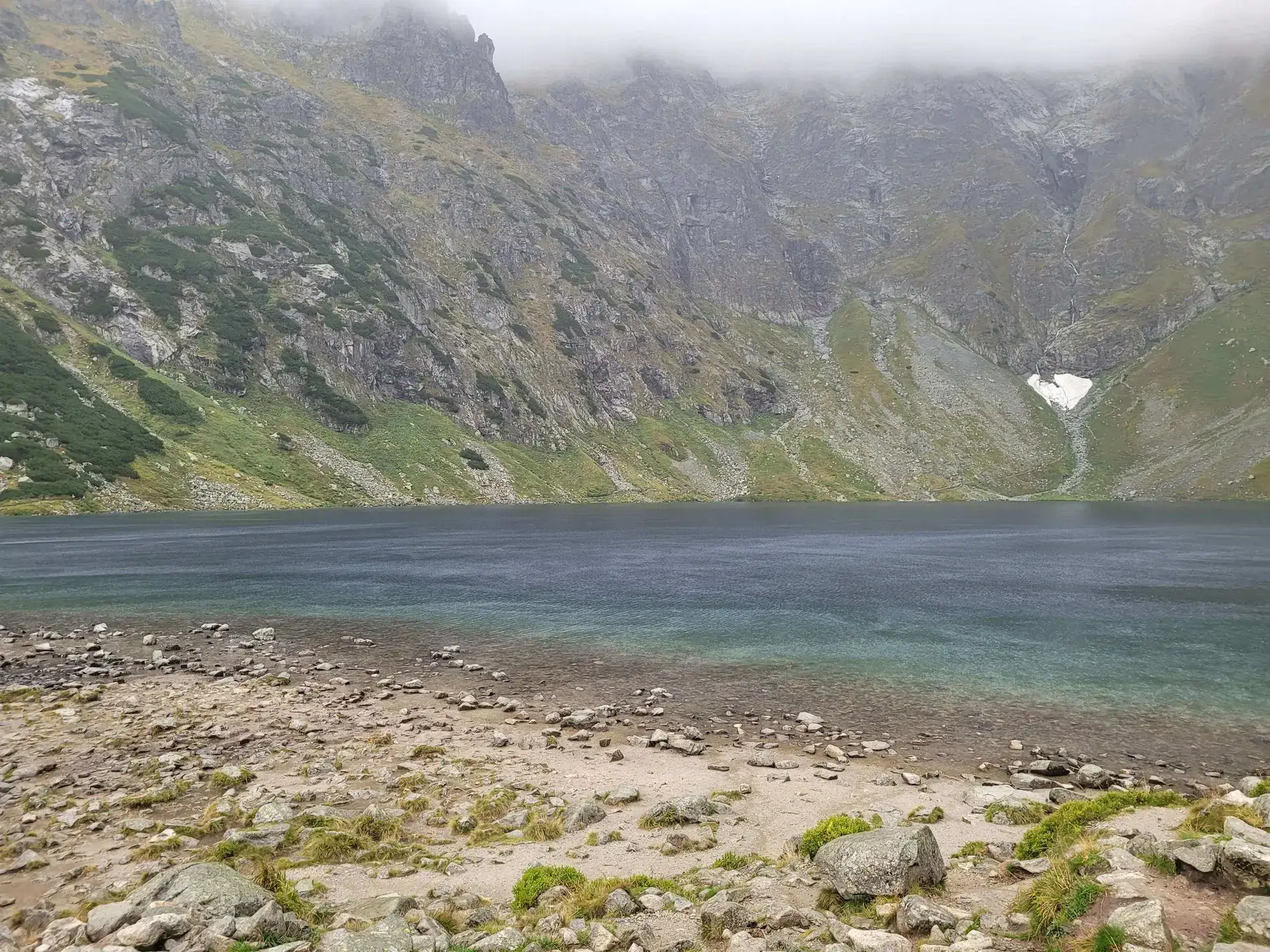
Morskie Oko often appears on lists of easy attractions, but let us be honest: the asphalt road from Palenica Białczańska is about eight kilometres one way. Technically it is easy. For fitness, for some people it absolutely is not. This is a suggestion for people who do not want a mountain trail, but are ready for a long walk.
If you are going there with a child, an older person or someone after an injury, count the time for the return and do not assume the pace of a brisk walk. In season you also get the crowd, a constant slalom between people. An early start gives you more quiet, and a smaller chance that you will see the whole lake from behind other visitors’ backs.
When the weather says no, do not negotiate
Many people plan low-effort Tatra sights as a backup for rain. That is a good instinct, as long as it does not end in a cable-car ride high into a storm, or a walk on an icy pavement without the right shoes. In heavy rain, storms and a very strong wind, pick a valley, a museum, the thermal baths, or a quieter day in Zakopane and nearby instead.
The view from Lomnický štít, Kasprowy or Hrebienok makes sense when you can actually see something. You are not buying a ticket to courage, or to the duty of ticking an attraction off. Sometimes the best decision is a coffee, a look at the forecasts, and moving the plan to a morning when the cloud has lifted.
A small pack still matters
Even for a short route, take water, something waterproof, an extra layer and a charged phone. Cash or a card, documents, and in winter a hat and gloves are worth having too. This is not an expedition, but in the Tatras the weather can turn an ordinary walk into a cold, wet chore.
If you have to pick only one option, match it to the day, not to the photo you want to post in the evening. The Tatras are at their best when you come back with the view in your memory, dry feet, and the feeling that you have left yourself a reason to come again.